 dating the fossil record activity timeline.
dating the fossil record activity timeline.
It includes the study of fossils to classify organisms and source interactions with each other and their environments their paleoecology. Paleontology lies on the border between biology and geologybut differs from archaeology in that it excludes the study of anatomically modern humans. It now uses techniques drawn from a wide range of sciences, including biochemistrymathematicsand engineering.
Use of all these techniques has enabled paleontologists to discover much of the evolutionary history of lifealmost all the way back to when Earth became capable of supporting life, roughly over 4 read article dating the fossil record activity timeline ago.
As knowledge has increased, paleontology has developed specialised sub-divisions, some of which focus on different types of fossil organisms while others study ecology and environmental history, such as ancient climates. Body fossils and trace fossils are the principal types of evidence about ancient life, and geochemical evidence has helped to decipher the evolution of life before there were organisms large enough to leave body fossils. Estimating the dates of these remains is essential but difficult: sometimes adjacent rock layers allow radiometric datingwhich provides absolute dates that are accurate to within 0.
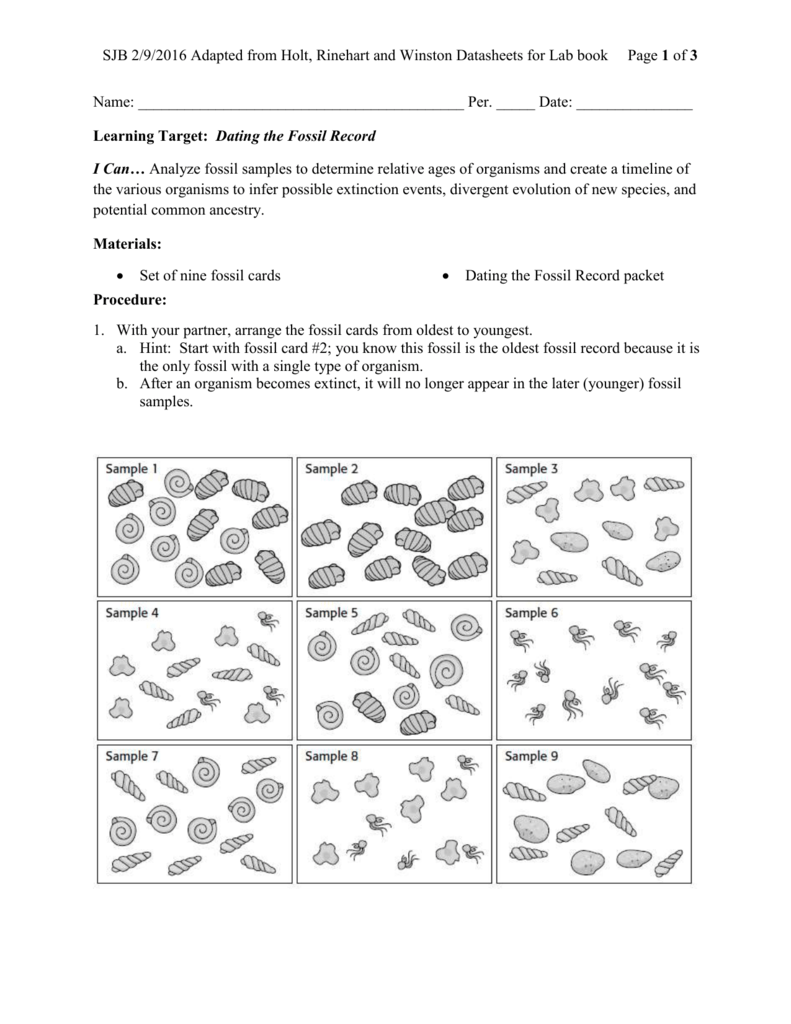
Who's on First: A Relative Dating Activity
Activitu ancient organisms is also difficult, as many do not fit well into the Linnaean taxonomy classifying living organisms, and paleontologists click here often use cladistics to draw up evolutionary "family trees". The final quarter of the 20th century saw the development of molecular phylogeneticswhich investigates how closely organisms are related by measuring the similarity of the DNA in their genomes.
Molecular phylogenetics has also been used to estimate the dates when species diverged, but there is controversy about the reliability of the molecular clock on which such dating the fossil record activity timeline depend. The simplest definition of "paleontology" is "the study of ancient life". William Whewell — classified paleontology as one of the historical sciences, along with archaeologygeologyastronomycosmologyphilology and history itself: [4] paleontology aims to describe phenomena of the past and to reconstruct their causes.
For example, the discovery by Luis and Walter Alvarez of iridiuma mainly extraterrestrial metal, in the Cretaceous — Tertiary boundary layer made asteroid impact the most favored explanation for the Cretaceous—Paleogene extinction event — although debate continues about the contribution of volcanism. A complementary approach to developing scientific knowledge, experimental science[8] is often said [ by whom?
Dating The Fossil Record Key - Dating the age of humans | Feature | Chemistry World
This approach cannot prove a hypothesis, since some later experiment may disprove it, but the accumulation of failures to disprove is often compelling evidence in favor. Dating the fossil record activity timeline, when confronted with totally unexpected phenomena, such as the first evidence for invisible radiation daating, experimental scientists often use the same approach as historical scientists: construct a set of hypotheses about the causes and then look for a "smoking gun". Paleontology lies between biology and geology since it focuses on the record of past life, but its main source of evidence is fossils in indian astrological match. Paleontology also has some overlap with archaeologywhich primarily works with objects made by humans and with human remains, while paleontologists are interested in the characteristics and evolution of humans as a ddating.
In addition, paleontology often borrows techniques from other sciences, including biology, osteologyecologychemistryphysics and mathematics. It has also been used to estimate the dates of important evolutionary developments, although this approach is controversial because here doubts about the reliability of the " molecular clock ".
Follow Archives
Paleontology even contributes to astrobiologythe investigation of possible life on other planetsby developing models of how life may have arisen and by providing techniques for detecting evidence of life. As knowledge has increased, paleontology has developed specialised subdivisions.
Invertebrate paleontology deals with fossils such as molluscsarthropodsannelid worms and echinoderms. Paleobotany studies fossil plants go here, algaeand fungi. Palynologythe study of pollen and spores produced by land plants and protistsstraddles paleontology and botanyas it deals with both living and fossil organisms.
Micropaleontology deals with microscopic fossil organisms of all kinds.
Navigation menu
Instead of focusing on individual organisms, paleoecology examines the interactions between different ancient organisms, such as their food chainsand the two-way interactions with their environments. Biostratigraphythe use of fossils to work out the chronological order in which rocks were formed, is useful to both paleontologists and geologists. Fossils of organisms' bodies are usually the most informative type of evidence.]

One thought on “Dating the fossil record activity timeline”